Balanced Scorecard – Benefits and Four Perspectives

Balanced Scorecard

Strategic planning is an essential activity in any organization. It sets priorities, supports the operations, focuses on resources, and ensures that all the stakeholders and employees work towards a common goal. To follow up with the strategic planning and performance management framework, a balanced scorecard (BSC) is used. It provides an easy platform to track financial and non-financial measures to find out the organization’s success and when remedial actions are required.

The balanced scorecard is used by government, business, and non-profits that would bring into line the various daily activities. The financial and non-financial measures are tracked using a balance scorecard to regulate the degree of the company’s growth and success and the time to execute the remedial actions if required.

The balanced scorecard is a popular management tool especially made use in the United States, Northern Europe, UK, and Japan. Organizations that look forward to a consistent performance gets more benefit out of it.  A Balance scorecard requires a good effort to implement and provides and effective outcomes. To make it successful, an organization must have the required skilled resources to make the balances scorecard a great success.

Read more

Importance Of Human Resource Management

Importance of Human Resource Management

Human resource management is a development-oriented approach that puts its onus on maintenance, utilization, development, and acquisition of human resources. It has been able to create a niche place for itself in an organization because it helps in the management to deal with some very serious issues related to recruitment, training, benefits, wellness, safety, organizational development, workplace communication, performance management, employee motivation, and compensation, etc.

Human resource management has a strategic role to play in accomplishing the objectives of the organization.  It flows from the values, vision, mission, and goals of an organization and the best part are that it has been able to create a balanced work environment that works in favor of both employees as well as the organization. This is the reason why companies are either creating a viable department in their own organization or outsourcing the services from human resource recruitment companies.

Read more

Importance Of Technology

Importance of Technology

Technological advancements and innovations have played an important role in the lives of human beings. It is a tool that has helped the world in functioning efficiently. Technology has improved lives by saving time and effort and making sure that operations are running in a smooth manner.

Technology is the use of new techniques, systems, and tools to make the work more productive. It puts its onus on making things happen so that the standard of living can be enhanced. The best thing about technology is that it is easy to use and this is why people do not hesitate to integrate it into their lives as well as business.

Read more

Line And Staff Organization Definition – Features, Advntages and Disadvantages

Line and staff Organization

Line and staff organization is a modified line organizational structure. In this organizational structure, the designation of different jobs is decided, and the relationship among them is clearly mentioned. Various methods can be used to structure jobs within an organization, but line organization and line and staff organization are the two most basic and simplest ways for creating job structure in an organization.

In a line organization, the top management has complete control and authority flows from top-level to bottom-level of the organization. Whereas, line and staff organization is modified line organization structure. In the line and staff organization, along with line organization staff departments are created—the role of staff departments to provide advice and support to the line managers.

Many organizations of different sizes, such as medium and large-scaled organization use line and organization structure because of its simple and efficient method to implement. In line and staff organizations, there are multiple layers of management in the organization.

In line and staff organization, the special staff is appointed and is attached to the line managers in order to provide them assistance in specialized activities. However, the power and control remain with the line executives. For example, when a managing director hires a secretary. The secretary might provide help in different work but will be considered a staff official and control remains with the managing director.

Read more

Benchmarking Definition – Types And Purpose

Benchmarking

Benchmarking is the method to measure a company’s performance based on services, products, and processes against the companies that are best in the industry. It provides valuable understandings that would help a company to understand where they stand with similar organizations. It also helps a company to identify systems, sales, or processes for enhancing. It could be either incremental or dramatic improvements.

When a study is performed against companies who perform better, breaking down the parameters that had caused them to be popular and then comparing those to your business would help you to improve your processes. For example, it could be to update a product’s features by comparing it with competitors, updating services that you provide, etc.

Improvements can take place in the following two ways:

  • Continuous
  • Dramatic

Continuous improvement takes place in an increment fashion. It involves only some small updates to fit into the requirement.

Dramatic improvement takes place by reengineering the entire work process internally.

Read more

Tannenbaum Schmidt Leadership Continuum | Definition and Advantages

Tannenbaum Schmidt Leadership Continuum

Various leadership styles are exercised by organizations to ensure the well-functioning of their company. These styles also aid in maintaining a healthy environment. Depending on the leadership style, the growth of the brand is determined. Either it can production-oriented or relationship-oriented. The right to choose remains solely with the organization.

One such model is the Tannenbaum Schmidt Leadership Continuum model.

The model showcases the relationship between the level of authority; leader, and the liberty this leader provides to his team.

The contingency approach debates that a leadership style must be based on the type of circumstance encountered and not on personal fondness.

In this post, we will dive deep into the world of Tannenbaum Schmidt Leadership Continuum and understand how this leadership model plays a significant role in business management and leadership. So, without any more ado, let us get started with the definition-

Read more

Emotional Leadership | Meaning and Style,

Emotional Leadership Styles

Leadership styles have proved to help managers or leaders pave their way forward in terms of growth for the organization and maintaining a healthy working environment for their team members.

Depending on the need, leaders have been often seen to indulge in various leadership styles. Many times, leaders only focus on improving the statistics of their organization. As a result, they fail to sustain a pleasant working environment for their subordinates.

Thus, leaders need to devote equal attention to the emotional aspects as well. A leader must not only have the skills to complete tasks with efficiency. He must be skilled and experienced enough to maintain a peaceful environment and a healthy relationship with his employees. A leader who inherits both these traits is good.

Leadership effectiveness is dependent on particular circumstances and a perfect blend of leadership styles used over time. Misuse, overuse or under-use of powers can lead to mismanagement, hence, failure of the job.

Read more

Difference between Transformational Leadership and Transactional Leadership

Transformational Leadership

Transformational Leadership and Transaction Leadership are the two most important types of leadership that play a significant role in senior management roles.

In case you are also keen to understand both of these leaderships and their key differences, so you can opt for the one that is best suited for you then this post is personalized to you.

In this article, we will be covering both Transformation Leadership and Transaction Leadership separately, and then we will help you in understanding when you should opt for a particular kind of leadership via our Transformational Leadership vs. Transactional Leadership analysis.

So, without any further ado, let us get started with Transformational Leadership-

Read more

Seven Transformations of Leadership | Characteristics of Leadership

The Seven Transformations of Leadership (2)

Leadership is essential for the proper functioning of an organization. It helps in strategizing and systematically carrying out all the tasks and duties. Except for this, goals are met timely, employee relations are maintained at a decent level.

Many times, companies inculcate specific leadership techniques that aid in transformation.

These transformations are necessary for the growth of an organization and to sustain its position in the industry.

David Rooke is an American leadership enthusiast and co-founder of Harthill Consulting, who specializes in evolving leadership within organizations. On the other hand, William R. Torbert is an American professor whose genre is to manage the behavior within organizations. Both of them, in 2005, wrote the book ‘Seven Transformations of Leadership’.

In their book, they have not explicitly emphasized on any particular leadership philosophy but focused on the personality of leaders and their management technique.

Understanding the Seven Transformations of Leadership Model

There are seven critical transformations in executive leadership competence today in the world. These transformations form the progressive stages in adult maturity, also referred to as Vertical Learning. It is in contrast to horizontal learning which takes place within a stage.

Rooke and Torbert have described the following seven leadership styles:

  • Opportunists
  • Diplomats
  • Experts
  • Achievers
  • Individualists
  • Strategists, and
  • Alchemists

All these seven different leadership styles have been laid down, keeping in mind all sorts of leaders and their management styles.

Read more

Blake Mouton Managerial Grid | Advantages and Disadvantages

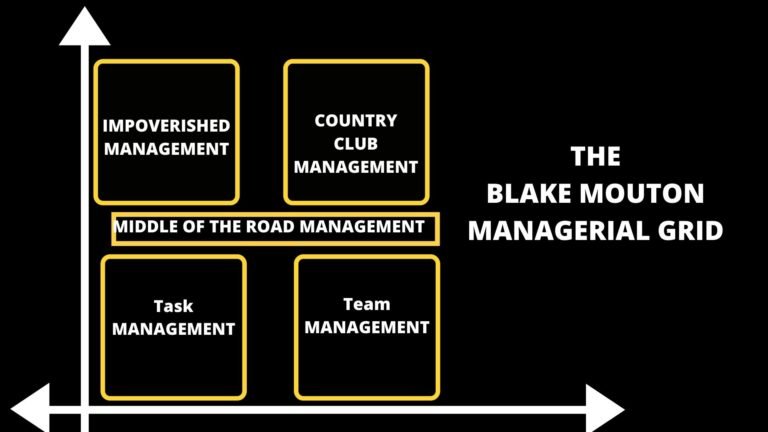
Blake Mouton Managerial Grid was developed by Robert Blake and Jane Mouton in 1964. It is also known as the leadership grid or managerial grid. This model identifies different leadership styles based on the concern of the manager for people and production.

Concern for people: this is the degree to which the leader takes into consideration the needs of his people, areas of development, etc. when deciding how a task is accomplished best.

Concern for results: concern for results is from leaders who emphasize only on objectives, organizational efficiency, and very high productivity. Their primary concern here is to increase and improve productivity at any cost.

Following are five different types of leadership styles as defined by Blake and Mouton:

Read more